
$10–$25/sq ft: Tile Installation Cost, Quote Checklist, Local Hiring
$10–$25/sq ft: Tile Installation Cost, Quote Checklist, Local Hiring
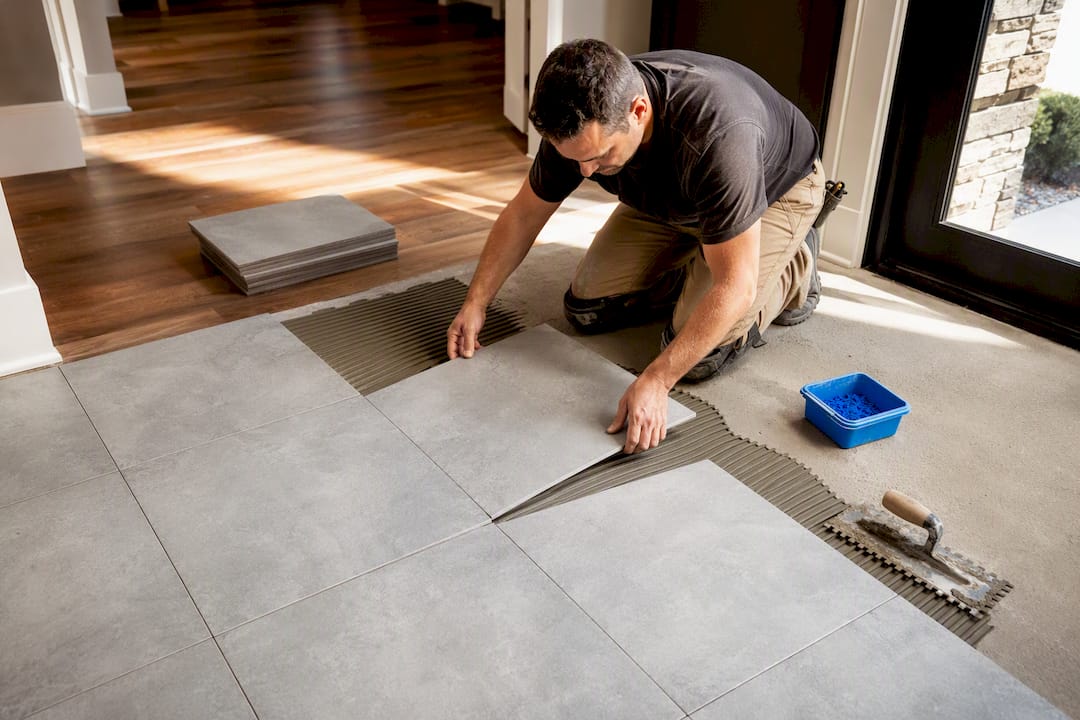
Installed tile runs about $8 to $60 per square foot when you count materials and labor together, with labor alone falling between $3 and $22 per square foot. Most standard ceramic or porcelain floors land in a narrower $10 to $25 per square foot band. Straight-set ceramic on a flat subfloor sits at the low end; natural stone, mosaic work, and custom shower surrounds push toward the top. Measure your square footage first, then collect multiple itemized quotes before committing to a price.
TL;DR:
- Most residential tile installations cost between $10 and $25 per square foot, with natural stone or mosaic tiles driving costs toward the higher end.
- Material choices, pattern complexity, substrate condition, waterproofing, and waste allowances significantly influence the final quote, often causing large bid discrepancies.
- Regional factors like ZIP code, project size, and hidden prep work can raise costs beyond initial estimates, especially for small or complex projects.
- Obtaining detailed, itemized quotes that specify waterproofing, substrate prep, and waste percentage helps prevent unexpected expenses during installation.
- Verified local installers with photos, licensing, and reviews streamline comparison and reduce the risk of unreliable bids or hidden costs.
Table of Contents
- How Much Does Tile Installation Cost Per Square Foot?
- What Actually Drives Your Quote Up or Down
- What Real Projects Actually Cost
- How to Get Quotes You Can Actually Compare
- Finding a Verified Installer Without the Guesswork
- Where the Standard Advice on Tile Budgets Falls Short
- Ready to Compare Tile Installers Near You?
- Where to Check Local Estimates and Benchmarks
- Sources
- FAQ
How Much Does Tile Installation Cost Per Square Foot?
The range is wide because “tile installation” covers everything from a $2 ceramic square in a laundry room to hand-cut marble in a curbless shower. National data puts the all-in installed range at $8 to $60 per square foot, but most homeowners doing a standard ceramic or porcelain floor should plan on $10 to $25 per square foot installed. Labor by itself typically runs $3 to $22 per square foot, averaging $8 to $15 for a typical residential job.
Homewyse’s calculator breaks this down at the line-item level. Its baseline estimate for a standard floor install comes to $16.38 to $20.21 per square foot, covering labor, setting materials, and a standard equipment allowance. That number tracks closely with what most licensed contractors quote for a mid-range porcelain floor in good condition.
Here’s how the categories typically break out:
| Tile category | Material cost (per sq ft) | Installed cost range (per sq ft) |
|---|---|---|
| Budget ceramic | $1–$5 | $8–$15 |
| Standard porcelain | $3–$10 | $10–$20 |
| Natural stone (marble, travertine, slate) | $8–$22 | $8–$60 |
| Glass or mosaic tile | $10–$25 | $20–$60 |
| Backsplash (small area) | $3–$15 | $15–$35 |
| Shower surround | $5–$20 | $22–$50 |
A few things move these numbers up or down before you even get to pattern or prep work:
- Your ZIP code affects cost, with labor rates often higher in major metropolitan areas compared to rural ones.
- Smaller projects typically have higher per-foot prices than larger ones, due to fixed costs being spread over less area.
- Calculators from ProjectCostPro apply metro-level multipliers to convert these national bands into a number closer to your actual ZIP code.
What Actually Drives Your Quote Up or Down
Two homes with identical square footage can get wildly different bids, and the gap almost always comes down to five factors: material choice, pattern, substrate condition, waterproofing, and waste.
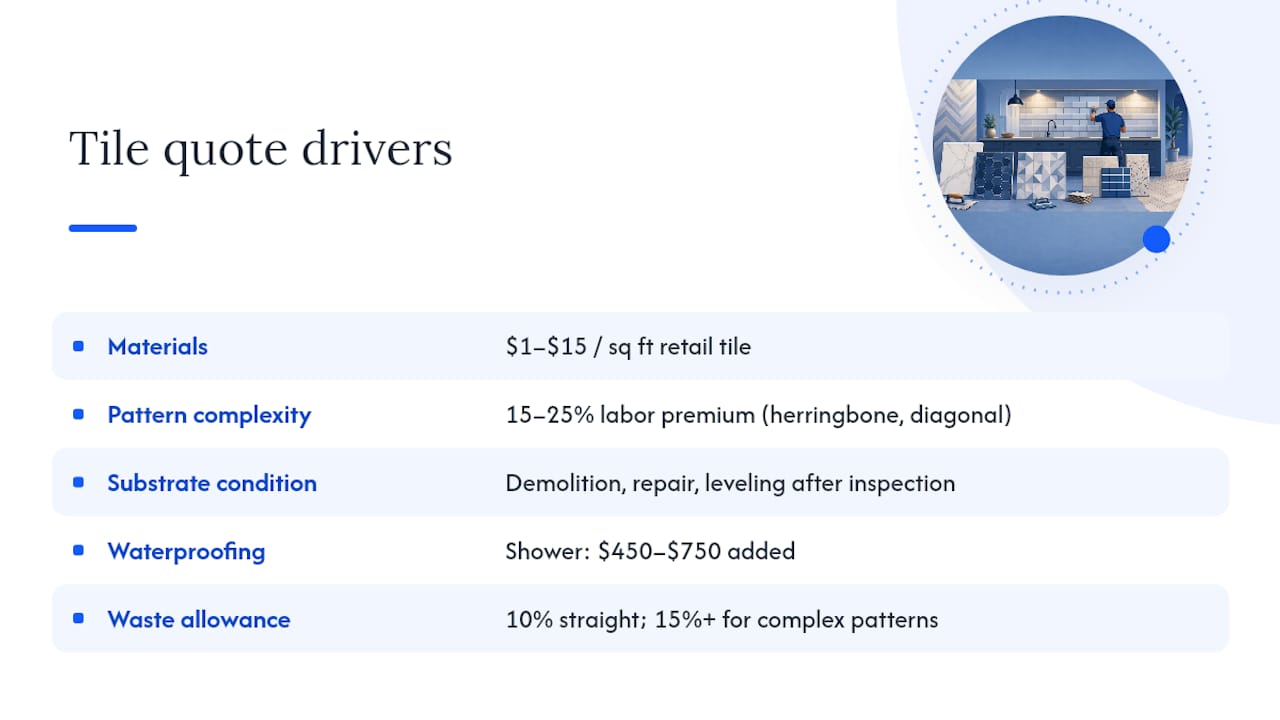
Materials. Ceramic tile retail prices range from $1 to $15 per square foot, depending on size, finish, and where it’s manufactured. Porcelain generally runs a bit higher than ceramic for comparable quality. Natural stone and glass mosaic sit at the top of the material range, and their fragility during cutting also drives labor costs higher.
Pattern complexity. A straight-set layout is the fastest, cheapest way to install tile. Herringbone, diagonal, and chevron patterns take longer to lay out and generate more cuts, so installers typically add a 15% to 25% labor premium for these layouts. Large-format tile lowers grout-line labor but raises the bar on substrate flatness. If your slab isn’t dead level, expect extra labor for leveling before a single tile goes down.
Substrate prep and hidden costs. Costs for demolition, subfloor repair, and leveling can be significant and often arise only after a contractor inspects the site in person.
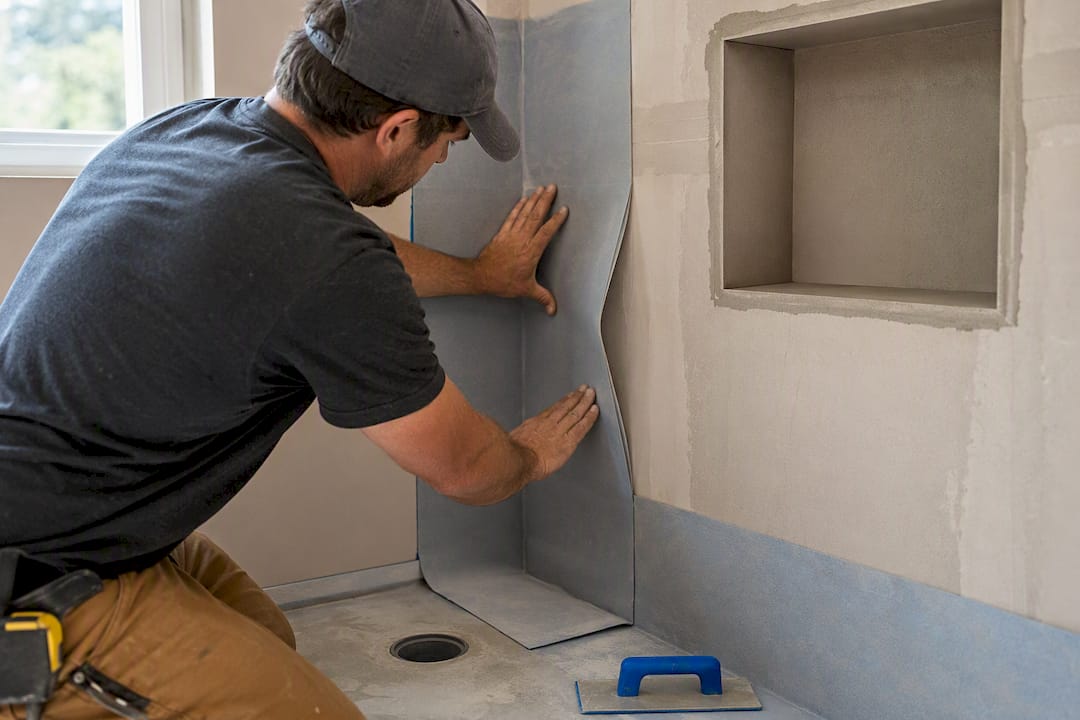
Waterproofing. Shower waterproofing alone typically adds $450 to $750 to a bathroom project, depending on whether the installer uses a sheet membrane or a liquid-applied system.
Setting materials. Thinset mortar, grout, and backer board commonly add $2 to $5 per square foot on top of the tile itself.
Waste allowance. Standard practice is a 10% waste allowance for straight layouts, rising to 15% or more for diagonal cuts, herringbone, or small-format mosaic, per ProjectCostPro’s calculator model.
Pro Tip: Ask your contractor to write the waste allowance percentage directly into the quote, tied to your specific pattern choice. A vague “materials as needed” line is where budgets quietly blow past their ceiling.
What Real Projects Actually Cost
Numbers on a spreadsheet only mean so much until you map them to an actual room. Here’s how a few common projects typically shake out.
- 50-square-foot bathroom floor. Ceramic tile lands around $500 to $1,250 installed. Add natural stone and that same footprint can run $900 to $2,250.
- Shower surround (roughly 60 square feet of wall tile). Budget $1,300 to $3,000, with waterproofing folded into that range. Curbless entries and niche shelves add labor time beyond this baseline.
- 35-square-foot kitchen backsplash. Expect $525 to $1,750, with glass or mosaic tile pushing the upper end.
- 200-square-foot kitchen floor. A standard porcelain install runs $2,000 to $5,000; upgrading to large-format tile or a herringbone layout can push that past $6,000.
- 1,000-square-foot whole-home floor. At the practical $10 to $25 per square foot range, that’s $10,000 to $25,000, with regional labor rates and material grade swinging the total significantly.
This Old House reports that homeowners spend roughly $2,000 on average on a typical ceramic tile project, with professional per-square-foot costs ranging much wider once you factor in scope and material grade. What usually pushes a project above the high end of its range isn’t the tile itself. It’s substrate repair the contractor didn’t anticipate, a switch to natural stone mid-project, or custom trim and transition pieces that get added once the design is finalized.
How to Get Quotes You Can Actually Compare
Two contractors can look at the same bathroom and hand you numbers $2,000 apart, and it’s rarely because one is trying to overcharge you. It’s because they’re pricing different scopes without telling you.
Ask every contractor the same set of questions, in writing:
- What’s included in the per-square-foot price: demo, disposal, substrate prep, or are those separate line items?
- What waterproofing system will you use, and can you name the specific product?
- What’s your waste allowance percentage for this pattern, and is it built into the quote?
- What tile brand and model are you specifying, and does the quote match what I picked out?
- Do you carry liability insurance and a current contractor license, and can I see proof?
- What’s the project timeline, including any dry time between steps?
- What warranty do you offer on labor, separate from the manufacturer’s tile warranty?
- Can I see photos of a completed job similar in scope to mine?
Pricing formats vary. Some contractors quote a flat per-square-foot installed rate, others bill hourly, and larger commercial-scale jobs sometimes come as a flat project price. To compare bids fairly, convert everything to a per-square-foot number and confirm what that number includes before you compare it to another bid.
Watch for a few red flags: a bid that’s dramatically lower than the others without a clear reason, a scope description that says “tile bathroom” with no waterproofing method named, or a contractor who can’t produce a single reference from a past client.
Pro Tip: Request an itemized line for prep work specifically. Contractors who bundle “labor” into one lump sum are often the ones who surprise you with a change order once they pull up the old flooring.
Finding a Verified Installer Without the Guesswork
Getting three quotes is good advice that’s hard to execute when you’re cold-calling contractors off a search results page with no way to verify who’s legitimate. Some online platforms solve that specific problem by letting you search “tile installer” plus your ZIP code and pull up verified business profiles for providers who work in your area.
Each profile includes details that matter for vetting: photos of past work, license information, and customer reviews, all in one place instead of scattered across five different sites. That matters because the questions in your contractor checklist, licensing, insurance, and past work, are exactly what a verified profile surfaces before you ever pick up the phone.
- Compare multiple installers side by side without repeating your project details to each one individually.
- Filter by ZIP code so you’re only seeing pros who actually service your area.
- Use verified reviews and photos to shortlist two or three contractors worth an in-person estimate.
Where the Standard Advice on Tile Budgets Falls Short
Most cost guides hand you a single per-square-foot number and call it a budget. That’s the wrong way to plan a tile project, because the number that actually matters isn’t the material rate. It’s the gap between what a contractor quotes over the phone and what they charge once they see your subfloor.
Homeowners consistently underweight substrate condition and waterproofing when they build a mental budget, then get blindsided when a “simple bathroom retile” comes back 40% over what they expected. The fix isn’t finding a cheaper contractor. It’s asking about substrate condition and waterproofing method before you compare a single dollar figure.
DIY makes sense only if you already own the tools and have done this before; a first attempt often costs more in wasted material and redo labor than hiring a pro from the start, per This Old House’s own comparison. If you’re budgeting a whole-home project, treat the per-square-foot range as a starting point, not a ceiling, and build in 15% for the surprises that show up once demo starts.
— Service
Ready to Compare Tile Installers Near You?
Certain platforms give you a faster path than cold-calling contractors off a generic search: search “tile installer” plus your ZIP code and pull up verified profiles with photos, licensing details, and real reviews, side by side, instead of chasing that information down one phone call at a time.

Once you’ve got two or three candidates, request itemized quotes using the checklist above and confirm each bid covers the same scope: waterproofing method, substrate prep, and waste allowance for your specific pattern. That’s how you avoid the surprise change order that turns a $12,000 floor into a $16,000 one. Head to Bestservicelocal to search local installers by ZIP code and start requesting quotes today.
Where to Check Local Estimates and Benchmarks
For a ZIP-specific number, run your project through a calculator rather than relying on national averages alone.
- TileHub’s cost guide — national benchmark report with per-square-foot ranges by tile type.
- ProjectCostPro’s tile calculator — ZIP-based calculator with metro multipliers and waste modeling.
- Homewyse’s tile floor calculator — line-item calculator breaking out labor, supplies, and equipment costs.
- This Old House’s ceramic tile cost guide — benchmark report on average project spend.
Sources
- Tile Installation Cost in 2026: Budget Per Square Foot
- Tile Cost Calculator (2026) | Shower, Bath, Backsplash
- Cost To Install Ceramic Tiles (2026 Guide)
- Cost to Install Tile Floor
FAQ
How much does it cost to lay 1,000 square feet of tile?
At the practical $10 to $25 per square foot range for standard ceramic or porcelain, a 1,000-square-foot job typically runs $10,000 to $25,000, including materials and labor.
How much does it cost to tile a 12x12 room?
A 12x12 room is 144 square feet, so at $10 to $25 per square foot installed, expect costs to vary depending on tile choice and pattern complexity.
How much do tiles cost for a 2,000-square-foot house?
Using the same $10 to $25 per square foot band, a full 2,000-square-foot home will have costs that vary widely based on tile grade and substrate repair needs.
How much does it cost to install tile through a big-box retailer?
Big-box retailers typically price installation using the same per-square-foot framework as independent contractors, generally in the $10 to $25 per square foot range for standard materials, though exact current pricing is best confirmed directly with the retailer since it varies by location and promotion.
Is DIY tile installation actually cheaper than hiring a pro?
DIY can save on labor costs, but only if you already have the tools and experience. Without that, material waste and mistakes on your first attempt often erase most of the savings compared to hiring a professional installer.