
Budget Your Long Distance Move: $2,700–$10,000 Line Item Checklist
Budget Your Long Distance Move: $2,700–$10,000 Line Item Checklist

A long-distance move typically runs $2,700 to $10,000, with most two- to three-bedroom households moving around 1,000 miles landing between $3,500 and $8,500. The three numbers that actually set your price are shipment weight, total mileage, and the service level you choose, from full-service crews to a rental truck you drive yourself. Get a binding estimate or run a virtual survey before you book, and you’ll know your real number instead of guessing.
TL;DR:
- Minimum charges for long-distance moves can be almost the same regardless of shipment size, significantly impacting small or studio moves.
- Additional fees such as fuel surcharges, packing, accessorial charges, and valuation coverage can increase your bill by 20% or more over the base estimate.
- Booking during off-peak seasons, midweek, and 4 to 8 weeks in advance can lower costs, while binding estimates protect against unexpected charges.
- Reducing shipment weight through decluttering or optimally scheduling your move is the most effective way to cut overall costs.
Table of Contents
- How Much Do Long Distance Movers Cost by Home Size and Distance?
- How Do Movers Calculate Long-Distance Moving Costs?
- What Fees Show Up on a Long-Distance Moving Quote?
- Full-Service Movers vs. Containers vs. Truck Rental: What’s the Real Cost Difference?
- When Is the Cheapest Time to Book a Long-Distance Move?
- What Should You Prepare Before Requesting a Moving Quote?
- Why You Can Trust This Long-Distance Moving Cost Breakdown
- Does Moving Insurance Change Your Total Cost?
- How Much Do Storage and Appliance Servicing Add to Your Move?
- How Do You Avoid Hidden Fees on a Long-Distance Move?
- What Questions Should You Ask to Compare Mover Quotes Fairly?
- The Single Biggest Lever Most People Ignore
- Get Verified Local Mover Quotes Without the Cold-Calling
- Verify Licensing and Tax Rules Before You Book
- Sources
- FAQ
How Much Do Long Distance Movers Cost by Home Size and Distance?
Your price tag depends less on “long distance” as a category and more on how much stuff you’re hauling and how far it’s going. A studio moving 500 miles and a four-bedroom house moving 2,500 miles are both “long distance moves,” but they might as well be different services.
Here’s how the numbers generally break down, based on typical weight per home size and standard tariff pricing:
- Studio or 1 bedroom (2,000–3,000 lbs): $1,800–$4,500 for 150–500 miles; $2,700–$6,000 for 1,000+ miles.
- 2 bedroom (4,000–6,000 lbs): $2,800–$6,500 for 150–500 miles; $3,500–$8,500 for 1,000 miles; $5,500–$11,000 for 2,500 miles.
- 3 bedroom (7,000–9,000 lbs): $4,000–$8,500 for 500 miles; $6,000–$12,000 for 1,000 miles; $8,500–$15,000 for 2,500 miles.
- 4+ bedroom (10,000+ lbs): $6,500–$12,000 for 500 miles; $9,000–$16,000 for 1,000 miles; $12,000–$20,000+ for cross-country distances.
These are wide ranges on purpose. Weight varies enormously within a home size category depending on how much furniture, how many boxes, and whether you’re bringing a piano or just a mattress. According to Extra Space Storage’s moving cost guide, a typical two- to three-bedroom household moving roughly 1,000 miles lands in the $3,500 to $8,500 band with a full-service crew, which lines up closely with the industry averages above.
One thing that surprises a lot of first-time long-distance movers: minimum charges. Every carrier sets a baseline charge regardless of how little you’re shipping, and that floor doesn’t move much whether you’re sending 800 pounds or 1,800. A recent benchmark study found that minimum charges have risen and tend to disproportionately affect studio and one-bedroom shipments, proportionally. If you’re moving a small apartment, you’re often paying almost as much per pound as someone moving a full house, because the carrier still has to send a truck and crew regardless of load size. Consolidating your shipment or shedding low-value bulky items before the move can meaningfully change that math.

How Do Movers Calculate Long-Distance Moving Costs?
Interstate movers price your shipment using a formula regulated by the Federal Motor Carrier Safety Administration: weight times mileage times tariff rate. Carriers weigh your loaded truck, then weigh it again empty, and the difference becomes your certified shipment weight, the number that determines your bill. Under FMCSA rules, you’re entitled to see those weight tickets, and you should always ask for them.
By the numbers: Tariff pricing for long-distance moves in 2026 typically runs $0.55 to $0.85 per pound per 1,000 miles, and cross-country distances multiply that 1,000-mile base rate by roughly 2.0 to 2.5 times.
The industry shorthand for this pricing unit is CWT, short for “hundredweight,” meaning the rate charged per 100 pounds of shipment weight. A mover’s tariff might quote $45 per CWT for a 500-mile move and $68 per CWT for 2,000 miles. Multiply that rate by your total weight in hundreds of pounds, and you get your base transportation charge before any add-ons.
Distance doesn’t scale in a straight line either. Moving companies group mileage into bands, and crossing into a new band (say, from 999 miles to 1,001) can bump your per-pound rate more than the extra two miles would suggest. Before you sign anything, verify the carrier’s USDOT number through the FMCSA’s household goods search tool. It takes two minutes and confirms you’re not handing your furniture to an unlicensed operator.
What Fees Show Up on a Long-Distance Moving Quote?
A moving estimate is really a stack of separate charges, and understanding each line item is how you catch a lowball quote before it becomes a shock invoice. The base transportation charge (weight times distance times tariff) is just the starting point.
Here’s what else typically appears:
- Fuel surcharge: Tracks weekly diesel prices and usually adds 5% to 14% on top of the line-haul charge, fluctuating with the market.
- Packing labor and materials: Professional packing can add $300–$1,500 depending on home size; boxes, tape, and padding are often billed separately from labor.
- Origin and destination labor: Loading and unloading crews charge by the hour or fold this into the binding estimate.
- Stair carry and long carry fees: Extra charges apply when movers can’t park the truck close to your door or have to haul boxes up multiple flights.
- Shuttle service: If a full-size truck can’t access your street, a smaller shuttle vehicle bridges the gap, typically adding $200–$600.
- Storage-in-transit: Needed when your delivery date doesn’t line up with your move-out date.
- Vehicle transport: Shipping a car separately from your household goods runs $600–$1,500 depending on distance.
- Valuation coverage: Basic released value protection is often included at minimal per-pound compensation, while full value protection typically costs 1% to 3% of your shipment’s declared value and can add hundreds of dollars to your total.
Pro Tip: Ask every mover to itemize accessorial fees separately in writing before you sign. A quote that just says “all-inclusive” without a fee breakdown is the easiest place for a low estimate to balloon on move day.
Full-Service Movers vs. Containers vs. Truck Rental: What’s the Real Cost Difference?
Your service level changes the price more than almost anything else in this whole process. Here’s how the three main options stack up for a representative 1,000-mile, two-bedroom move.
- Full-service movers: $3,500–$8,500. Crews pack, load, drive, unload, and sometimes unpack. Best for people with more money than time, or anyone who can’t physically manage heavy lifting.
- Portable containers (PODS-style): $2,000–$5,000. You load it, the company drives it, you unload it. A genuine sweet spot for households that wants to save money without a 1,000-mile solo drive, as long as flexible delivery windows work for your schedule.
- Truck rental (DIY): $1,200–$3,000 including fuel, tolls, and equipment rental. Cheapest option by far, but you’re driving a 26-foot truck across multiple states, doing all the loading, and absorbing all the risk of damage or breakdown.
The tradeoff isn’t just money. Full-service movers hand off nearly all the physical labor and liability, containers split the difference, and truck rental puts everything on you, including hundreds of miles behind the wheel of a vehicle you’ve probably never driven before. Transit time also varies. A full-service mover might deliver in 7 to 14 days depending on route consolidation, while a container or rental truck arrives whenever you drive or schedule it.
When Is the Cheapest Time to Book a Long-Distance Move?
Timing changes your price more than most people expect. Move during peak season, which runs May through September, and you can expect quotes 20% to 30% higher than the same move booked in November or February. Summer is when families move around school schedules, so demand spikes and movers price accordingly.
A few practical moves that consistently lower your bill:
- Book midmonth and midweek. End-of-month and weekend dates are the most requested and the most expensive; a Tuesday in the third week of the month is often your cheapest slot.
- Reserve 4 to 8 weeks out. This gives you leverage to compare multiple bids instead of settling for whoever has a truck available next week.
- Ask for a binding estimate, not a “not-to-exceed” or non-binding quote. A binding number locks your price against the surveyed weight, which protects you from surprise add-ons later.
- Negotiate off published rates. Many carriers have room to discount 5% to 15% off their base tariff, especially during slower months, so it’s worth asking directly.
Pro Tip: If your dates are flexible, tell the mover upfront. Some carriers will shave hundreds off the price just for the ability to slot your shipment into a truck that’s already headed your direction.
What Should You Prepare Before Requesting a Moving Quote?
The accuracy of your estimate depends entirely on the information you hand over. Vague answers get vague quotes, and vague quotes turn into disputes on move day.
Before you contact any mover, gather this:
- A room-by-room inventory, including furniture, boxes, and anything oversized like a piano, gun safe, or pool table.
- Special item details: fragile art, antiques, or anything requiring custom crating.
- Access notes for both addresses: stairs, elevators, long walkways from curb to door, or any street where a full-size truck can’t park.
- Firm or flexible dates, since flexibility is your biggest negotiating chip.
- Storage needs, if your old and new move dates don’t line up cleanly.
Once you have quotes in hand, insist on a binding estimate, ask for a sample weight ticket format, and request every accessorial charge itemized rather than bundled. That contingency line matters more than people think. It’s the buffer that keeps a surprise fee from wrecking your budget on delivery day.
Why You Can Trust This Long-Distance Moving Cost Breakdown
The numbers in this guide come from FMCSA tariff rules, published fuel data, and industry benchmark studies, not guesswork or a single company’s sales pitch. That matters when you’re about to hand a mover a few thousand dollars and hope they show up.
Some platforms list local movers with verified business profiles, service areas searchable by ZIP code, and side-by-side comparison features to help avoid chasing multiple phone calls for different answers. Instead of cold-calling companies you found through a search engine, you can search by service type and ZIP and compare details from multiple providers in one place. This approach can help users collect quotes that are easier to trust and compare.
Does Moving Insurance Change Your Total Cost?
Valuation coverage, the industry’s term for moving insurance, is one of the biggest variables buyers overlook when comparing quotes. Every FMCSA-regulated mover has to offer two options: released value protection and full value protection.
Released value is the default, and it’s nearly free because it’s nearly worthless. It covers your belongings at a flat rate of 60 cents per pound, regardless of actual item value. A 50-pound television that gets crushed in transit nets you $30. Most people don’t realize this is the automatic coverage unless they specifically upgrade.
Full value protection is the real coverage option, and it typically costs 1% to 3% of your shipment’s total declared value. On a shipment you declare at $50,000, that’s $500 to $1,500 added to your total bill, but it means the mover has to repair, replace, or cash-settle for the full value of anything lost or damaged. Some carriers also let you buy third-party moving insurance for high-value items like jewelry or fine art that fall outside standard coverage limits anyway.
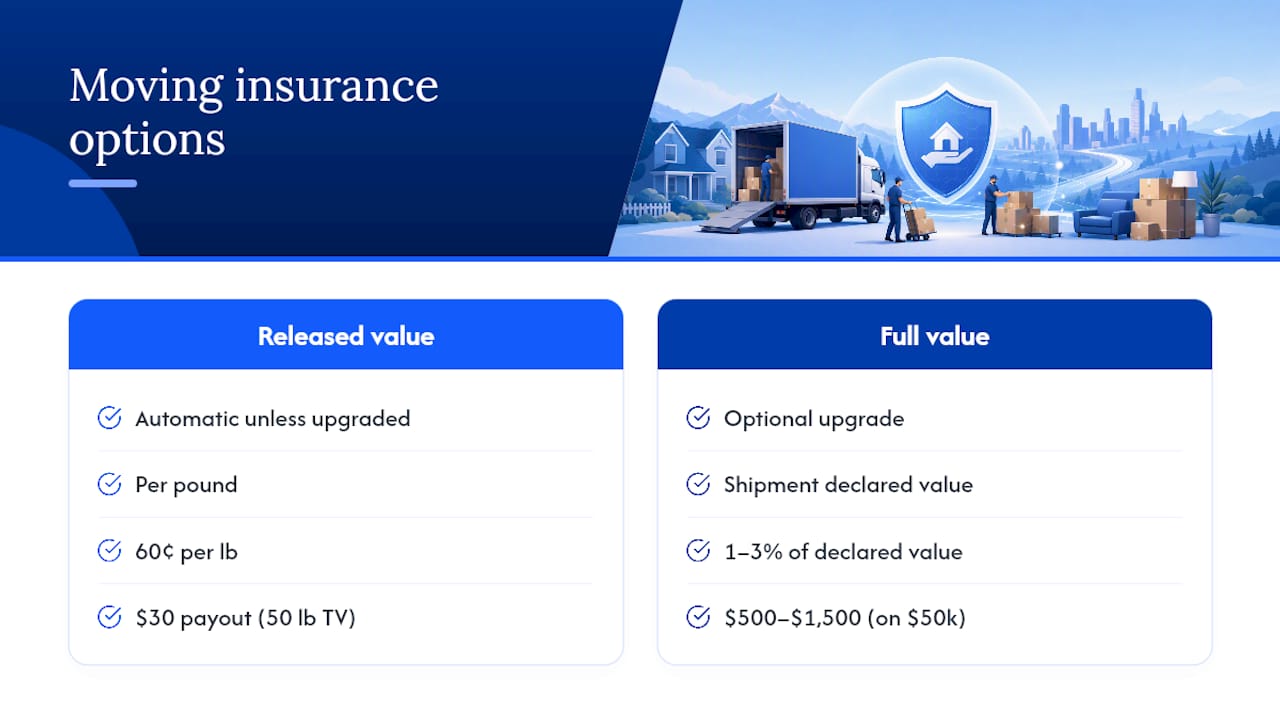
The math here is simple: skip full value protection to save a few hundred dollars, and you’re gambling that nothing breaks. For most households, especially ones with newer furniture, electronics, or anything irreplaceable, the upgrade is worth the added line item on your quote.
How Much Do Storage and Appliance Servicing Add to Your Move?
Storage and appliance prep are two add-ons that quietly inflate a moving budget, and both are easy to plan for once you know the ranges.
Storage-in-transit becomes necessary whenever your move-out date and move-in date don’t line up, which happens constantly with closing delays or lease overlaps. Expect to pay roughly $150 to $400 per month depending on shipment size and region, plus a handling fee to move items in and out of the warehouse. Some movers bundle a set number of storage days into their binding estimate, so it’s worth asking before you assume you’ll need to pay extra.
Appliance servicing covers disconnecting and reconnecting washers, dryers, refrigerators with ice makers, and gas stoves. Many movers won’t transport a washer without draining the lines first, and gas appliances often require a licensed technician rather than the moving crew itself. Budget $50 to $150 per major appliance for disconnect and reconnect service, more if gas line work is involved.
Neither of these costs is optional in most moves, so building them into your baseline estimate from the start beats discovering them as a surprise add-on on moving day.
How Do You Avoid Hidden Fees on a Long-Distance Move?
The gap between a quoted price and a final bill almost always comes down to a handful of predictable traps. Watch for these before you sign anything.
A lowball non-binding estimate is the most common one. Some movers intentionally quote low to win your business, knowing the final weight-based charge will come in higher. Insist on a binding estimate or a “not-to-exceed” guarantee tied to an in-home or virtual survey, not a phone guess.
Inventory changes are another trap. If you add furniture or boxes after the estimate, your weight goes up and so does your bill, sometimes by more than the new items would suggest because it can bump you into a new pricing tier. Keep your inventory list updated and shared with the mover right up until moving day.
Cash-only deposits and no written contract are red flags worth walking away from entirely. A legitimate FMCSA-licensed carrier provides a written estimate, a bill of lading, and accepts standard payment methods. Finally, watch for vague “additional services” language on a quote. If a line item isn’t spelled out in dollars, ask for clarification before you sign, not after the truck is loaded.
What Questions Should You Ask to Compare Mover Quotes Fairly?
Comparing three quotes that all say “$4,500” doesn’t mean you’re comparing the same service. The real comparison happens in the details underneath that number.
Start by confirming each quote is binding, not an estimate that can shift once the truck is weighed. Then check whether the price includes full packing, partial packing, or none at all. One mover’s “$4,500” might include professional packing materials and labor, while another’s identical number assumes you pack every box yourself.
Ask each company directly about their fuel surcharge policy, since that line item can swing 5% to 14% depending on current diesel prices, and confirm whether it’s locked in at booking or adjusted at delivery. Check accessorial fees for your specific situation: does your new place have stairs, a long walkway, or a street too narrow for a full-size truck? Get those charges in writing rather than assuming they’re included.
Finally, verify each carrier’s USDOT number through the FMCSA registry before comparing a single dollar figure. A quote from an unlicensed operator isn’t a bargain, it’s a liability. Once you’ve confirmed licensing and matched up what’s actually included in each number, the real cheapest option usually becomes obvious, and it isn’t always the smallest number on the page.
The Single Biggest Lever Most People Ignore
Weight reduction beats almost every other cost-saving tactic combined, because it multiplies across the entire tariff rather than shaving a flat fee. Booking off-peak comes second. Before anything else, gather three binding estimates, verify each carrier’s USDOT number, and go through the room-by-room checklist above. That’s the difference between a number that matches your invoice and one that doesn’t.
— Service
Get Verified Local Mover Quotes Without the Cold-Calling
Comparing long-distance movers usually means either scrolling endless search results or handing your phone number to five different lead-generation sites that sell it to a dozen call centers. Bestservicelocal takes a different approach: search by service type and ZIP code, and you get verified business profiles you can actually compare side by side, not a flood of robocalls.

You see real details for each provider instead of guessing from a five-star badge with no context behind it. That transparency matters most on a purchase this size, where a few hundred dollars of difference often comes down to who’s licensed, who’s local, and who actually answers the phone. If a long-distance move is on your calendar, start by searching your ZIP code on the Bestservicelocal homepage to pull up verified movers and other local service providers serving your area, and request quotes directly from profiles you trust.
Verify Licensing and Tax Rules Before You Book
Before signing with any carrier, confirm its authority to operate through the FMCSA’s household goods search tool, which shows USDOT registration and safety history. Fuel surcharges tied to your quote track weekly diesel price data from the EIA, so expect some fluctuation between your estimate and final bill. And if you’re hoping to deduct moving costs from your taxes, check current IRS guidance on moving expense deductions first, since most job-related moves no longer qualify under current tax law.
Sources
- Household Goods Search — FMCSA
- Gasoline and Diesel Fuel Update — EIA
- Can I deduct my moving expenses? — IRS
- How much do movers cost? — Extra Space Storage (moving guide)
FAQ
How Much Should I Budget for a Long-Distance Move?
Budget $2,700 to $10,000 depending on your home size, distance, and service level, with most two- to three-bedroom moves around 1,000 miles landing in the $3,500 to $8,500 range. Add a 10% contingency on top of your binding estimate to cover accessorial fees like stairs, storage, or fuel surcharge fluctuations.
How Much Does It Cost to Move 1,000 Miles Away?
A 1,000-mile move for a two-bedroom household typically costs $3,500 to $8,500 with a full-service mover, based on standard tariff rates of roughly $0.55 to $0.85 per pound at that distance. Portable containers run $2,000 to $5,000 for the same move, and DIY truck rental can drop to $1,200 to $3,000.
Are Long-Distance Movers Worth It?
For most households, yes, especially if you value your time, have limited physical ability to lift heavy furniture, or are moving a large home. Full-service movers cost more than DIY options but eliminate the risk of driving a rental truck across state lines and the labor of loading and unloading everything yourself.
Can I Deduct Long-Distance Moving Costs on My Taxes?
Most job-related moving expenses are no longer tax-deductible under current federal rules, a change from older tax law that many people still assume applies. Check the IRS’s current guidance before assuming any part of your move qualifies, since exceptions exist for specific groups like active-duty military.
How Do I Find Reliable Long-Distance Movers Near Me?
Search by service type and ZIP code on a platform like Bestservicelocal to compare verified business profiles instead of relying on generic search results. Always cross-check a carrier’s USDOT number through the FMCSA registry before signing any contract.