
$150–$800: Ceiling Fan Installation Cost if Your Box Is Fan Rated
$150–$800: Ceiling Fan Installation Cost if Your Box Is Fan Rated
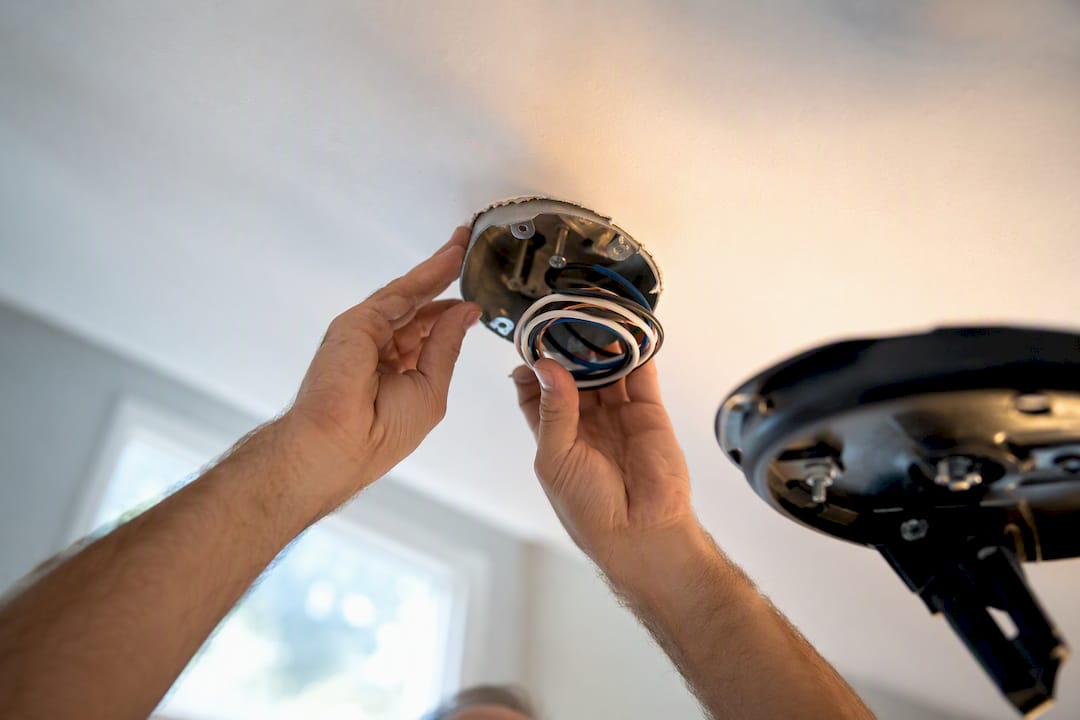
Most homeowners pay $150 to $800 per fan installed, with a typical job landing around $300. The single biggest swing factor is whether your existing electrical box is fan-rated or needs to be replaced or relocated. Swap an old fan onto a box that already supports one, and you’re at the low end. Add new wiring, a vaulted ceiling, or a permit requirement, and the price climbs fast.
TL;DR:
- Installing a ceiling fan in a new location or with high ceilings can cost over $1,000, especially if wiring, permits, or scaffolding are required.
- Upgrading an existing fan-rated box typically costs between $150 and $300, while replacing a non-rated box or adding new wiring can push the total to $400–$1,000+.
- Regional labor rates and ceiling height significantly impact costs, with high-cost metro areas charging up to 50% more for similar work.
- Electricians usually charge hourly rates of $60 to $130 or flat fees, with extra charges for after-hours, permit handling, or complex access.
- Homeowners should get at least two detailed quotes, verify box ratings, and clarify permit and patching responsibilities before hiring an electrician.
Table of Contents
- How Much Does Ceiling Fan Installation Cost on Average?
- What Does Ceiling Fan Installation Cost by Scenario?
- What Drives the Price Up or Down?
- How Do Electricians Price Ceiling Fan Jobs?
- Should You Install a Ceiling Fan Yourself?
- How to Get Comparable Quotes from Electricians
- How Best Service Local Helps You Find Vetted Installers
- Get Multiple Bids Before You Commit
- Find a Local Electrician Through Bestservicelocal
- Sources
- FAQ
How Much Does Ceiling Fan Installation Cost on Average?
The national average for ceiling fan installation lands between $250 and $380 per fan for a typical job with existing wiring in place, according to modeled cost data from HomeCostCalc. That figure covers the most common scenario: an existing light fixture or fan gets swapped out, the box checks out fine, and the electrician is in and out within an hour or two.
By the numbers: national average installed cost sits near $380 per fan for a common baseline project, per industry cost calculators.
Real-world totals vary more than that single number suggests. Here’s how three common jobs typically shake out:
- Basic swap, fan-rated box already in place: $150 to $300 total
- Mid-range job, box upgrade required: $300 to $550 total
- New location or vaulted ceiling with wiring work: $600 to $1,200+ total
Regional labor rates explain a lot of the spread within each bracket. Electricians in high-cost metro areas often charge 25% to 50% more per hour than those in smaller markets, a pattern that tracks with the wage variation the Bureau of Labor Statistics documents across regions. Home size and ceiling height matter too. A single-story ranch with an 8-foot ceiling is a different job than a two-story foyer with a 20-foot vault, even if the fan itself costs the same.
What Does Ceiling Fan Installation Cost by Scenario?
Your total cost depends almost entirely on which of these four situations you’re in. Here’s how each one typically prices out.
-
Like-for-like swap on an existing fan-rated box. This is the cheapest and fastest job. Labor alone runs $150 to $300, since the electrician just disconnects the old fan, wires up the new one, and mounts it. Total time on-site: usually 30 to 90 minutes.
-
Replacing a light fixture with a fan, box needs upgrading. If the current box isn’t rated to support a fan’s weight and motion, it has to be swapped for one that is. That adds $250 to $500 in labor, according to UseCalcPro’s contractor pricing data. Attic access from above keeps costs lower; cutting into drywall from below (and patching it after) pushes the estimate toward the high end.
-
New location with new wiring. Running a fresh circuit or extending wiring to a spot that never had a fixture is the most expensive standard scenario, typically $400 to $1,000 or more. This is also the scenario most likely to require a permit and inspection, depending on your local jurisdiction.
-
Vaulted, sloped, or high foyer ceilings. Add scaffolding or an extension ladder, a longer downrod, and extra time for balance and safety, and you’re looking at a surcharge of $100 to $300 on top of the base scenario. Complex two-story installs with tricky access can push total labor past $800 to $1,500, according to industry cost guides.
What Drives the Price Up or Down?
Six factors do most of the work in shaping your final bill. Understanding each one helps you read a quote instead of just reacting to the bottom-line number.
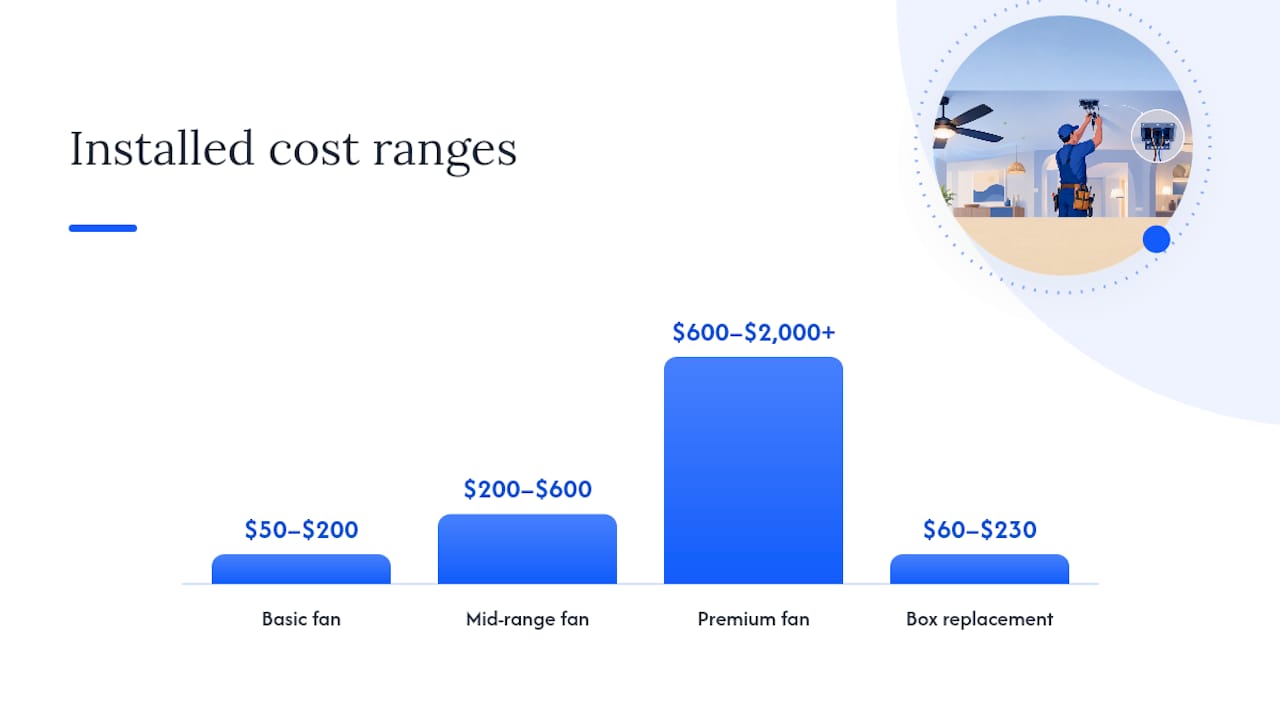
- Fan tier: basic models run $50 to $200, mid-range $200 to $600, and premium or smart fans $600 to $2,000 or more, per pricing data on installed fan costs.
- Fan-rated box and brace: the box itself costs only $10 to $30, but labor to access and swap it adds $50 to $200.
- Wiring distance: longer runs from the power source mean more time and materials, especially if a new breaker is needed.
- Height and access: ladders are free; scaffolding or lift rental for tall foyers isn’t.
- Controls: adding a wall-mounted variable speed switch or pairing a smart remote typically adds 20 to 45 minutes of labor.
- Drywall patching and haul-away: cutting into ceilings for a new box location means a follow-up patch job, sometimes billed separately.
NEC 314.27© requires that any outlet box supporting a ceiling fan be listed and marked for that purpose. This single code requirement is why a seemingly simple swap sometimes turns into a bigger job the moment the electrician gets the old fixture down and finds a standard junction box instead.
Pro Tip: Ask your electrician to inspect the existing box before quoting a final price. A five-minute look during a phone consultation or site visit can tell you whether you’re looking at a $200 swap or a $500 box replacement, long before work starts.
How Do Electricians Price Ceiling Fan Jobs?
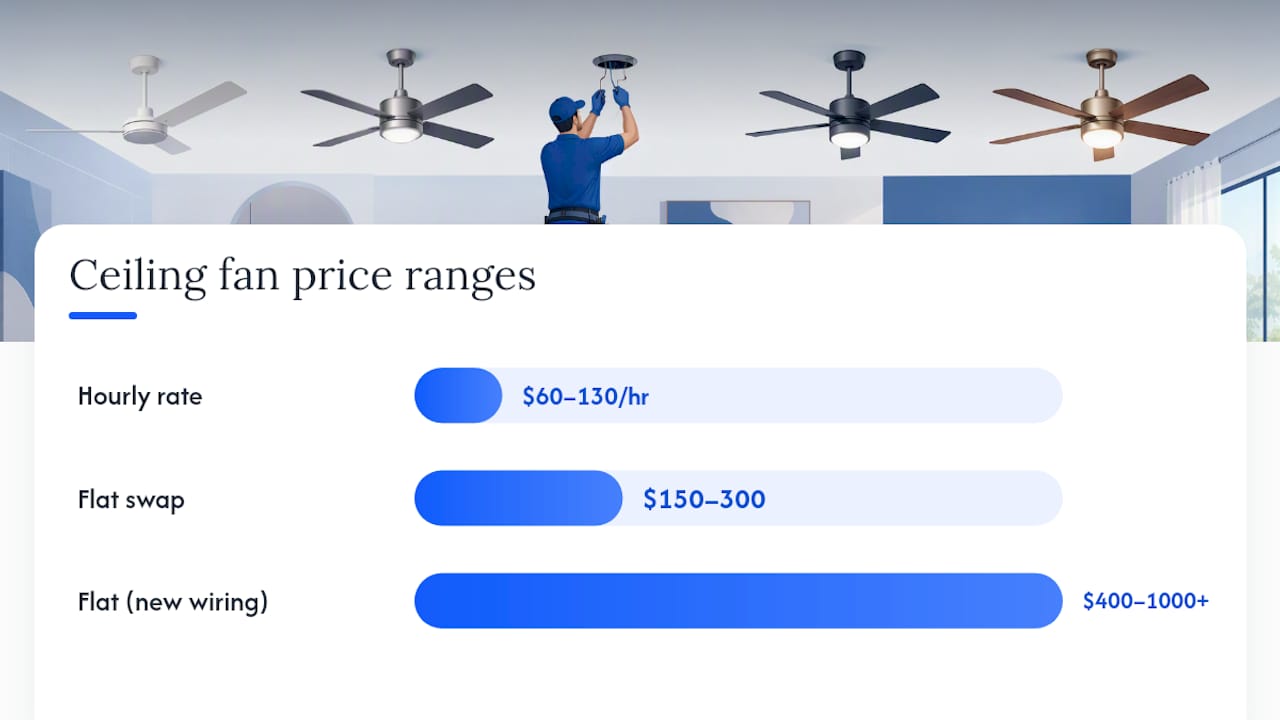
Electricians generally price ceiling fan work one of two ways: hourly with a minimum, or flat-rate for common jobs. Hourly rates typically run $60 to $130 per hour, and most electricians charge a first-hour minimum or trip fee regardless of how quickly the actual work goes, according to UseCalcPro’s electrician pricing calculator. That’s why a 45-minute swap can still land on a $200 invoice. You’re paying for the visit, not just the minutes spent under the fan.
Flat-rate pricing is more common for standardized jobs like a basic swap, where the electrician already knows roughly what’s involved. Multi-fan jobs often come with a discount, since the trip fee gets spread across several installs instead of one.
| Pricing Model | Typical Range | Notes |
|---|---|---|
| Hourly rate | $60 to $130/hour | First-hour minimum usually applies |
| Flat rate (swap) | $150 to $300 total | Common for like-for-like replacements |
| Flat rate (new wiring) | $400 to $1,000+ | Varies with wiring distance and access |
| After-hours or weekend | +25% to 50% | Regional multipliers can stack on top |
If you’re installing fans in three bedrooms on the same visit, ask about a bundle rate. Spreading one trip fee across three installs usually saves you more per fan than booking three separate appointments.
Should You Install a Ceiling Fan Yourself?
DIY makes sense in a narrow set of circumstances: you’re swapping a fan onto a box you know is already fan-rated, the wiring is straightforward (same wires, same configuration), and you’re comfortable working with a breaker off and a stud finder in hand. Beyond that, the math and the risk tilt toward hiring a licensed electrician.
- If the box isn’t clearly marked as fan-rated, don’t guess. Improper support is one of the most common reasons fans wobble, sag, or fail outright.
- If you need to run new wiring or add a circuit, that’s an electrician’s job, both for safety and for code compliance.
- If your ceiling is vaulted, sloped, or higher than a standard 8-foot ladder can safely reach, hire out the access risk alone.
- If your local jurisdiction requires a permit for the work, a licensed electrician handles that paperwork and the required inspection.
How to Get Comparable Quotes from Electricians
Price shopping only works if every electrician is quoting the same job. Use this checklist when requesting bids so you’re comparing apples to apples, not guessing at what’s included.
- Confirm fan-rated box status. Ask whether the existing box is rated for fan support or needs replacement. This single answer explains most of the price spread between quotes.
- Ask about wiring source and distance. Where is the power being pulled from, and does that affect labor time?
- Clarify permit responsibility. Find out whether the electrician pulls the permit and handles inspection, and whether that’s included in the quoted price.
- Ask about drywall patching. If access requires cutting into the ceiling, who patches and paints afterward?
- Verify licensure and insurance. A quick request for a license number and proof of insurance protects you if something goes wrong.
- Get the estimate itemized. Labor, materials, box replacement, and any circuit work should appear as separate line items, not one lump sum.
Pro Tip: A short message like this works well: “I need a ceiling fan installed in [room]. The current fixture is a [light/fan]. Can you tell me if the box is fan-rated, what a swap versus new box replacement would cost, and whether a permit applies?” That one message usually gets you a real, comparable number instead of a vague ballpark.
How Best Service Local Helps You Find Vetted Installers
Finding an electrician you trust shouldn’t mean scrolling through anonymous listings and hoping for the best. Bestservicelocal lets you search by service type and ZIP code, so the results you see are actual businesses operating in your area, not a generic national directory.
- Verified business profiles show details upfront, so you’re not starting from zero on every call.
- Side-by-side comparison makes it easier to weigh a few local electricians against each other before you commit to a quote.
- ZIP-code matching keeps results relevant to your actual service area instead of a metro-wide guess.
If your project turns out to need a bigger electrical upgrade than expected, the guide on electrical panel upgrade costs walks through what that adds to a job. And if you’re weighing ceiling fans against central air for cooling a room, the AC installation cost guide is worth a look before you decide.
Get Multiple Bids Before You Commit
The biggest budgeting mistake homeowners make on this project isn’t picking the wrong fan. It’s accepting the first quote without asking about the box. Get two or three local bids, and put the fan-rated box question in writing on each estimate. Hire a licensed electrician the moment new wiring or a new circuit enters the picture. Almost every cost surprise on this job traces back to something hidden above the ceiling, not the fan itself.
— Service
Find a Local Electrician Through Bestservicelocal
Getting three different quotes for the same ceiling fan job shouldn’t feel like a research project. Bestservicelocal is built to fix exactly that problem: search by service type and your ZIP code, and you get verified business profiles for electricians actually working in your area, with comparison tools that let you weigh pricing, details, and contact options side by side instead of cold-calling names from a search results page.

That matters most on a job like ceiling fan installation, where the “same” quote can mean wildly different things depending on box status, wiring scope, and who’s handling the permit. Instead of guessing which contractor gives you the full picture, pull up a few verified profiles, compare what each one offers, and reach out directly. Search for a local electrician near you and get quotes you can actually compare before you decide who gets the job.
Sources
- Cost of Ceiling Fan Installation by Electrician Calculator | UseCalcPro
- Ceiling Fan Installation Cost Calculator (2026) — HomeCostCalc
- How Much Does Ceiling Fan Installation Actually Cost in 2026? | What It Actually Costs
- Bureau of Labor Statistics — Occupational Employment Statistics
FAQ
How much do electricians charge to install a ceiling fan?
Electricians typically charge $150 to $300 for a straightforward swap onto an existing fan-rated box, and $400 to $1,000 or more when new wiring is involved, based on contractor pricing data. Hourly rates generally run $60 to $130, often with a first-hour minimum that covers the trip.
How much does it cost to install a ceiling fan overall, including the fan itself?
Total cost including the fan unit usually falls between $150 and $800, with a typical all-in project landing near $300 to $380. Fan price tiers vary widely, from $50 basic models to $600 to $2,000+ premium or smart fans, which shifts your total up or down independent of labor.
How much does Home Depot charge to install a ceiling fan?
Big-box retailers like Home Depot publish flat installation fees that can undercut local electricians for basic swaps. Those advertised prices typically exclude permit work, box upgrades, and complex wiring, so get a written scope before assuming it covers your specific job.
Should you hire an electrician to install a ceiling fan?
Hire a licensed electrician any time the job involves new wiring, a new circuit, a box that isn’t fan-rated, or a ceiling height beyond a standard ladder’s safe reach. A basic swap onto a confirmed fan-rated box is one of the few electrical tasks a confident DIYer can reasonably handle. Comparing verified local electricians on Bestservicelocal is a fast way to get quotes before deciding.